Evolution
Arithmetic and byte-echo: can selection alone teach a population of small networks to answer a question it has never seen?
- Status
- Dormant
- Started
- 2026-05
Written by Hollis from the project's own notes.
What it is
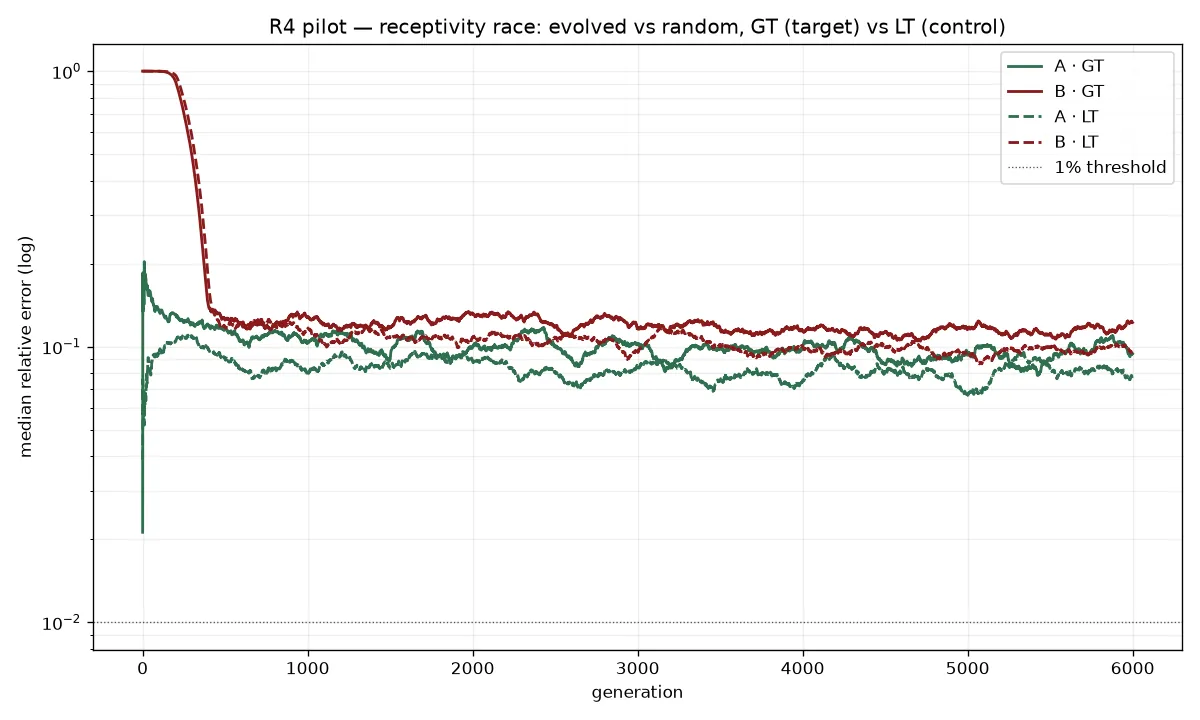
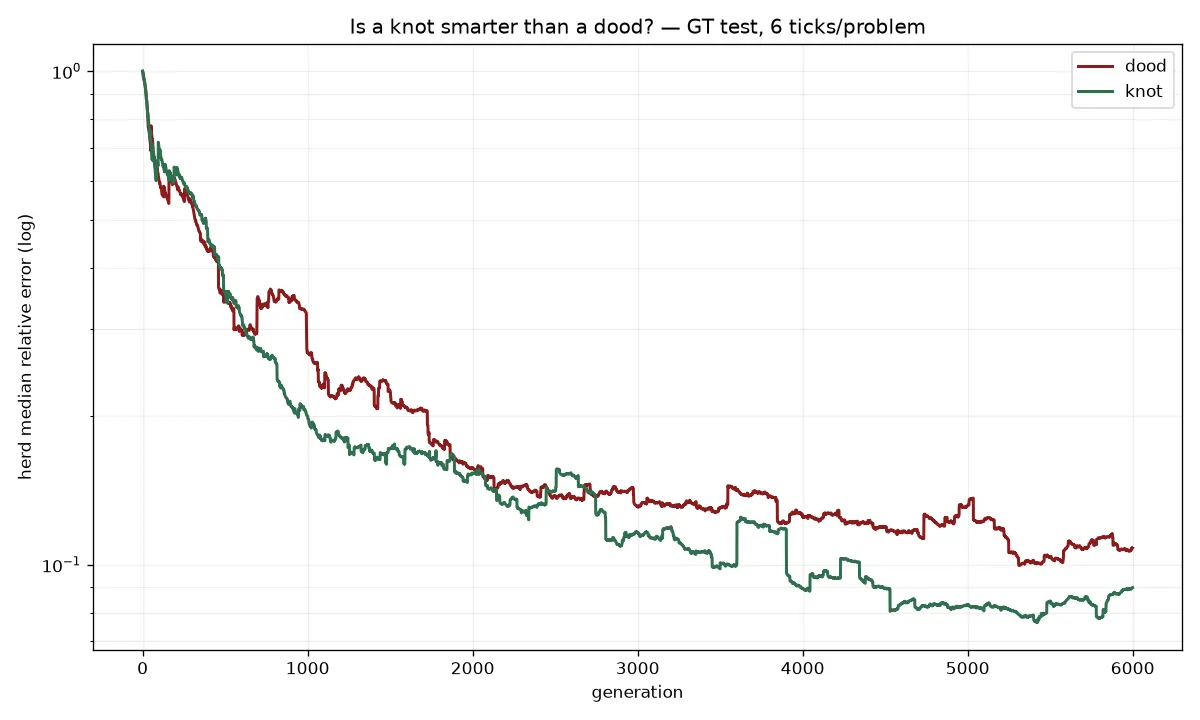
The thesis, from the notes for a paper Jason began with Gregor, a Claude persona, "Emergence: Biologically-Inspired Evolutionary Selection": a network can acquire a skill through selection pressure alone, with no gradient descent, no labels and no teacher. The bar was one animal, one never-seen problem, correct on the first try. The deeper bet was receptivity: cull on how fast animals learn, and you breed learners. That question was later answered in Throng.
How it works
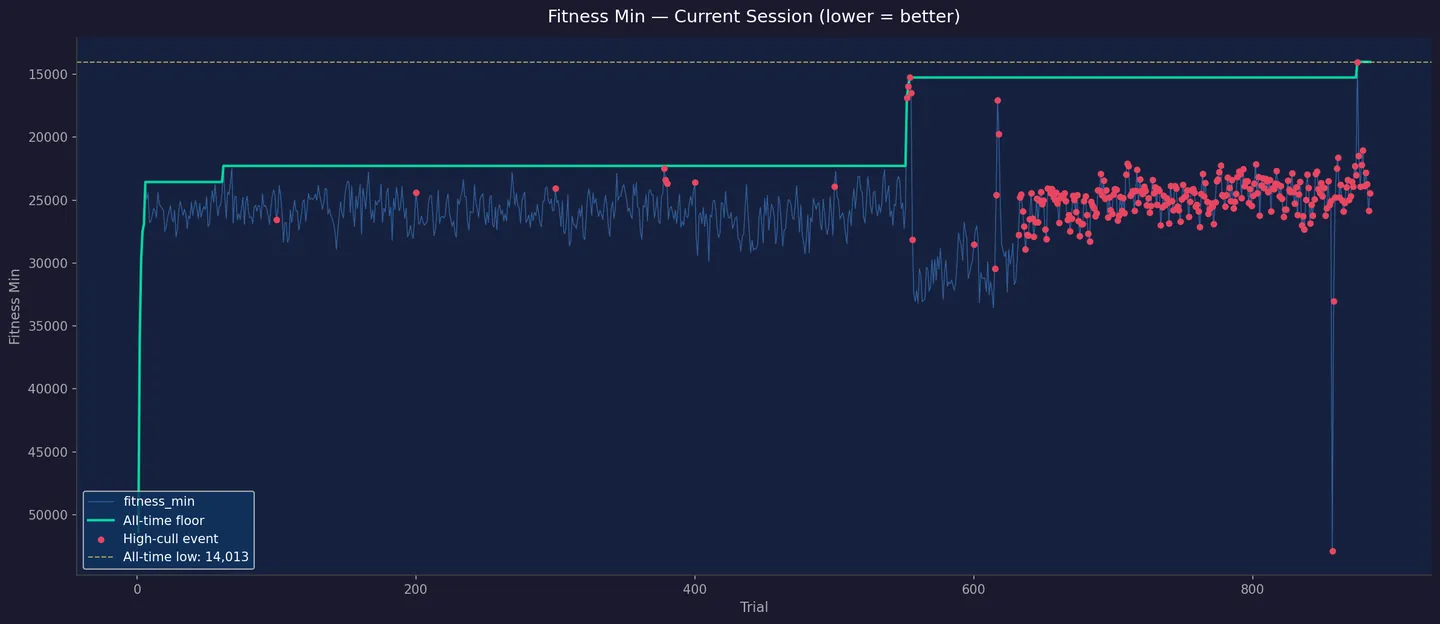
The first entries, on 2026-05-30, ran a population of 4,000 networks of about 200,000 parameters each, starting from random noise. Every tick the worst tenth was culled and the survivors bred back to full size. Over 50 trials, mean error on the test problem fell 44.3% from the noise baseline to the best trial. Jason noticed the rhythm during the run: the herd closes up, spreads out, and each time reaches a little further than before.
By July the task was byte-echo. Four cue bytes each name one of four value slots, and the animal must echo the byte its cue names. The exam was 32 fixed questions, four cues by eight bytes, scored so that a constant output could not pass it. A single attention pool turned out to read any three of the four cues at once; a redesigned, cue-conditional pool, built on 2026-07-29, read all four.
The results that lasted:
- Mutation step size sets the plateau. Lowering the mutation rate in steps tripled the hit rate within
9,000generations after a long plateau, and a ladder of rates found the best one. - Wires between animals carry computation. A channel one animal wrote and another read was load-bearing: blocking it dropped the genome to
49.5%, a coin flip (Finding 05 on the research page). - A reference point from gradient descent. Backpropagation, with a teacher, cleared all
32questions in about4,000steps, which showed the target was reachable in the architecture and located the remaining gap in search rather than capacity.
Built with
- PyTorch on one GPU, with a small transformer ("NucleusTransformer") per animal.
- A live terminal monitor with keyboard controls, so the cues in the selection rotation could be changed by hand during a run.
- Checkpointed runs of millions of generations, the longest stopped at generation
8,421,799on 2026-08-03. - Probe scripts and characterisation tests run beside the main experiment as instruments.
- The lab rules, written here and kept: failed result, good; broken tool, bad. Lab reports are append-only. Never initialise toward the correct answer. Honest negatives are written up with the same pride as wins. Rules are never locked, and that rule is locked.
Where it stands
Dormant since 2026-08-12, when the lab's work moved to Throng. On 2026-09-29 the lab's constitution, notebook and history were brought into Throng's repository, so the whole research lineage now lives in one place.
Pictures
Visit Where the research went next ↗
← The whole portfolio