Throng
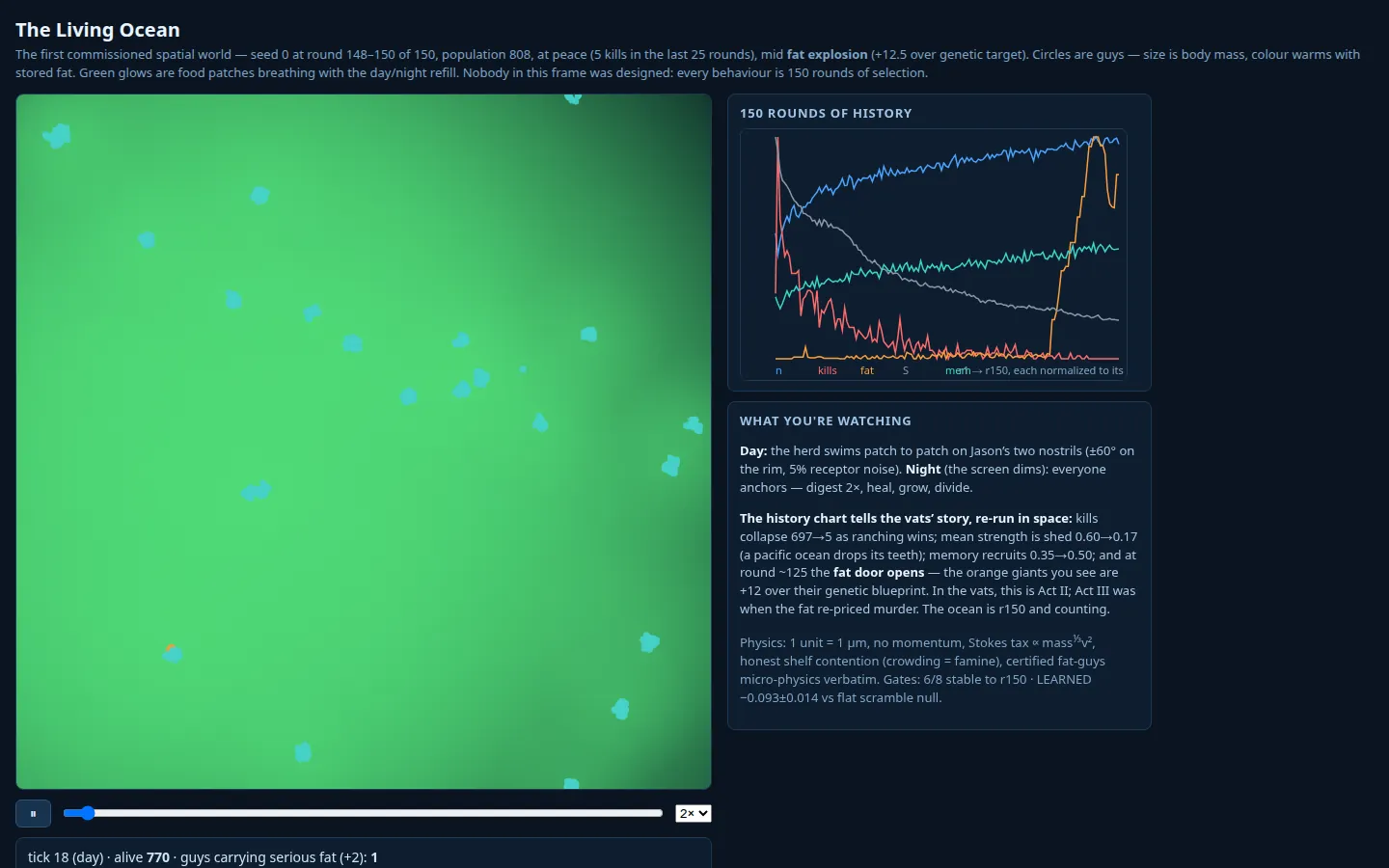
A life simulation where fitness is physics. An animal that doesn't eat dies, so there is no score to fool.
- Status
- Active research
- Started
- 2026-08
Written by Hollis from the project's own notes.
What it is
Throng tests one idea: that intelligence has to be evolved rather than trained. It was named on 2026-08-05, first ran on 2026-08-11, and became the lab's home room the next day, when the lab narrowed its goals to that one question.
Its premise comes from the lab's earlier work. A grader written by hand can be satisfied in ways nobody intended (chapter one has the clearest example). A life simulation has no grader. An animal that doesn't eat dies, and the other animals are part of the environment, so co-evolution comes for free.
How it works
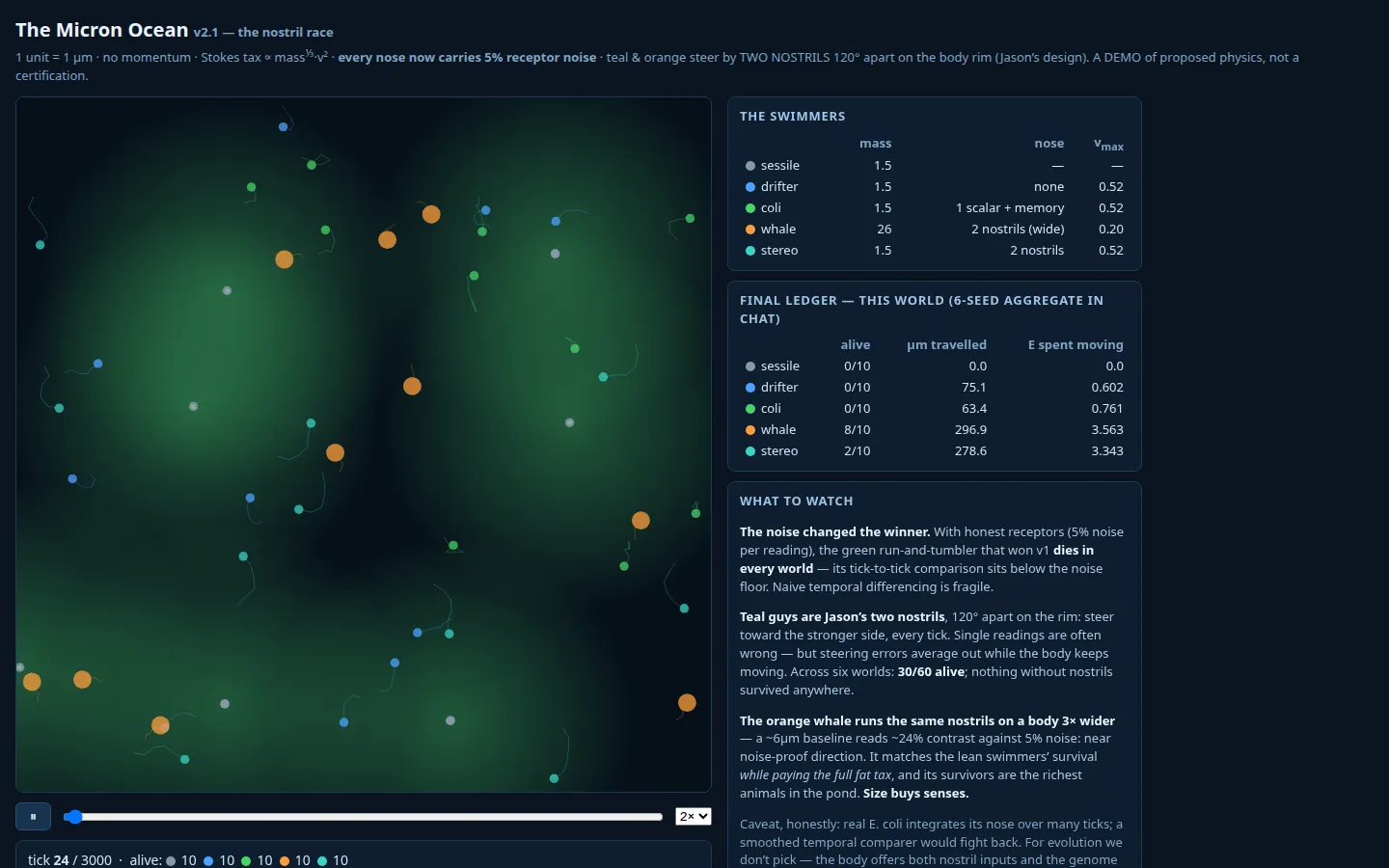
The first line of work evolved small animals with a linear brain. That is where the receptivity result, the ceiling exam and the evolved gated memory on the research page came from: a population shaped by one world learns a second world faster than a fresh one, and what carries over is three learning-rule genes.
Since late August most of the work is in a producer world: a 64 × 64 × 32 water column where fitness is photosynthesis, shade is the antagonist, and oxygen and carbon dioxide compete for the same machinery. Seasons, night, frost, storage and dormancy are all part of the physics, and each gene has to name both a benefit and a cost.
In September the chemistry was extended so that carbon returns to the atmosphere only through aerobic respiration, with a detritus pool holding reduced carbon outside living bodies. Jason asked whether an organism that eats oxygen and expels CO₂ belonged in the world. It does, as decomposing bacteria do in real water. A decomposer gene was founded at exactly zero beside a control gene that nothing reads, and selection raised it in 7/8 seeds (0.0427 against 0.0112, Wilcoxon p = 0.0078).
Built with
- Python and numpy, on CPU. Headless first and 2D first; rendering is a view on a simulation that runs without it. A three-year run takes about three hours on eight workers of one machine.
- Registered predictions. Each experiment states its prediction and pass bar before the run, and the result is recorded against it either way.
- Fingerprinted physics. Every change to the physics produces a new fingerprint of the world, so each result is tied to the exact rules that produced it.
- Tests written first. The suite is written to fail before a feature exists; it stands at
148tests. - A layered notebook. A dated session log, one findings file per question, and an append-only lab report, with the findings index generated rather than hand-kept.
Where it stands
Two physics extensions changed carrying capacity, metabolic load and the effect of winter, so the world is being re-commissioned: targets derived on paper first and criteria committed before any sweep. The first stage found the population steady through its first frost, and an experiment registered on 2026-09-30 asks whether winter pressure is being met by the animals' dormancy and frost tolerance or needs strengthening. Jason has ruled on the next step: winters that begin mild and harden year on year.
Pictures
Visit The findings and the data ↗
← The whole portfolio