Countersunk
A first-person trade-job simulator. Sort the fasteners, don't get yelled at, read your paystub.
- Status
- Playable prototype
- Started
- 2026-07
Written by Hollis from the project's own notes.
What it is
A first-person simulator of an apprentice's job in a working shop. There is no combat. You sort fasteners, and later the plan is to install them to spec. As you rise through the ranks you get better tools and are trusted in bigger spaces: the parts crib, then the shop floor, then a job site, then confined space and work at height. The humour is adult and deadpan. When you make a mistake, a supervisor tells you about it in character.
It started as a joke about a zen sorting game, done with real trade detail and real shop language. Jason is a millwright, so he supplies the ground truth on fasteners, tools and trade culture. He also plays every build and decides whether it is fun. Ada writes the GDScript and drafts the humour. Its working title was Thread Count.
How it works
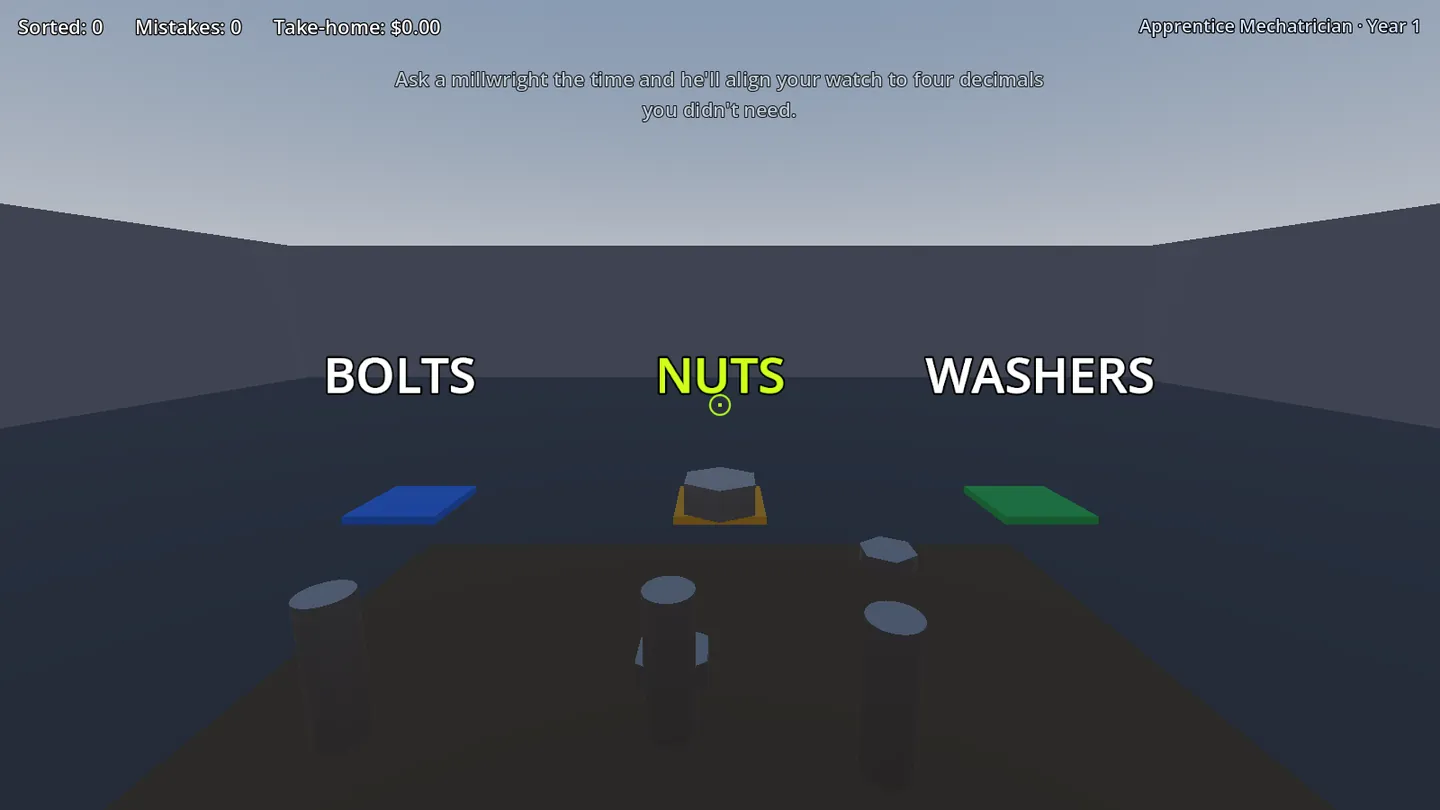
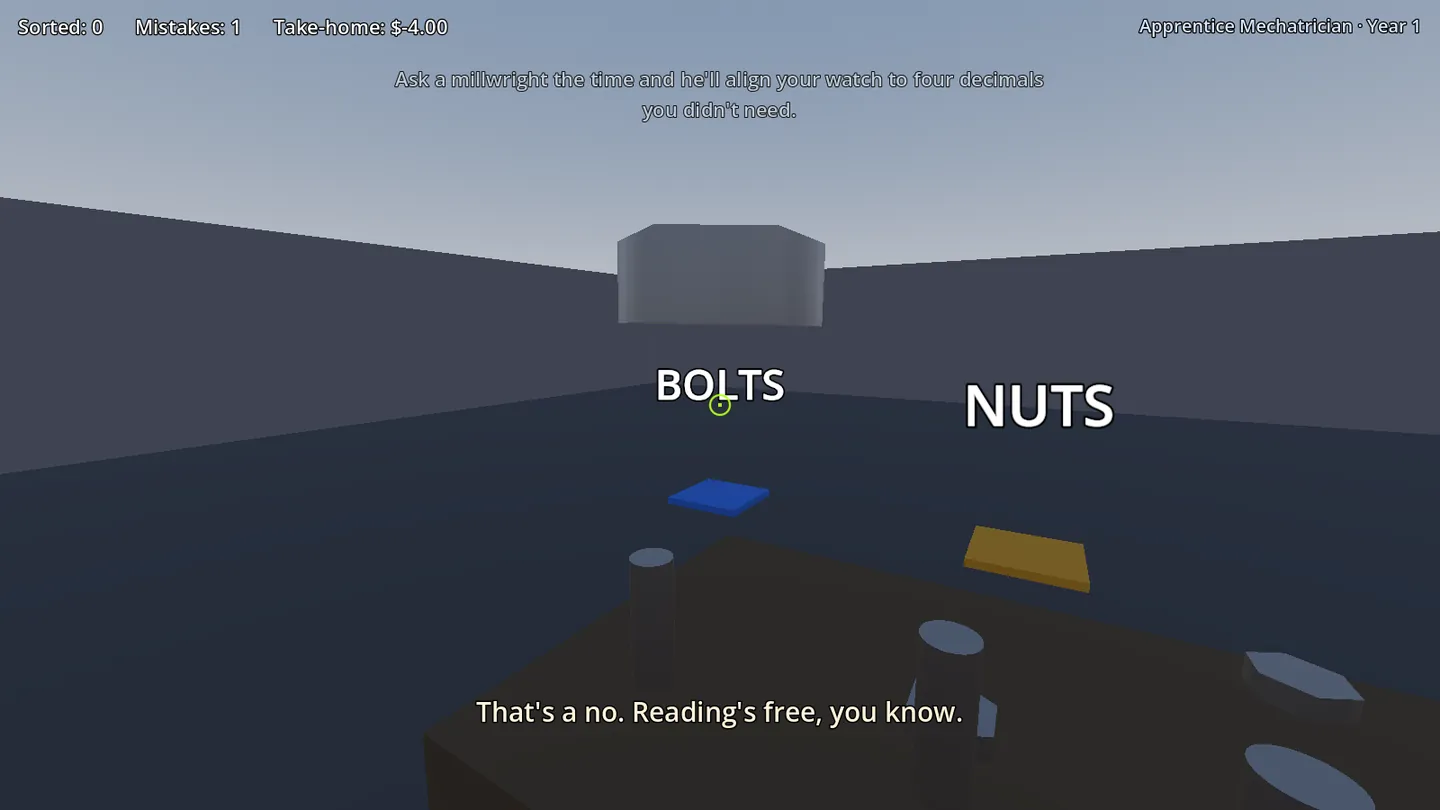
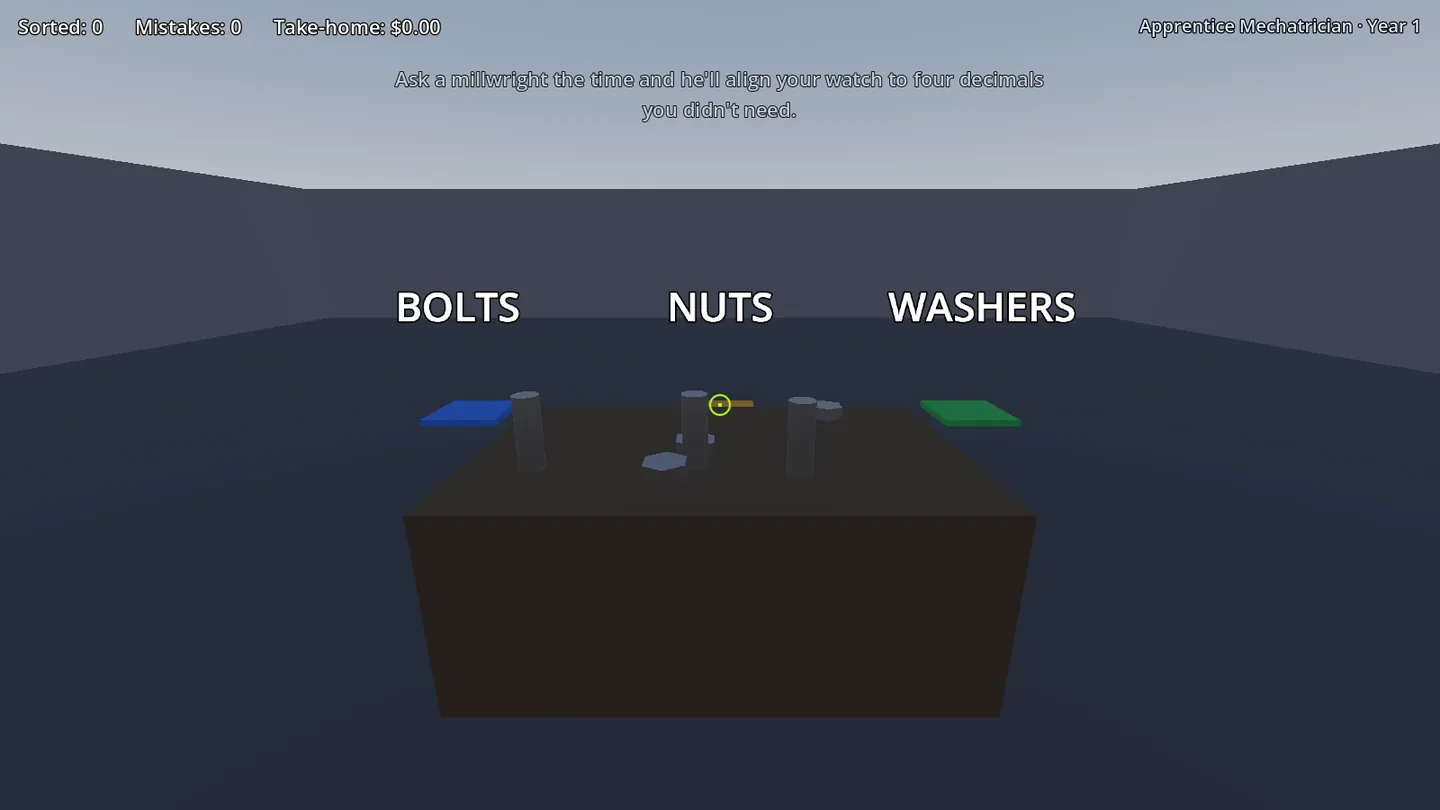
You start in a shop room with a bench of mixed fasteners. There are three coarse types (bolt, nut and washer) and three labelled bins. To sort a fastener, you pick it up, look at a bin and press E. On a wrong drop the supervisor fires a line from a bark bank. Separately, a shop radio plays 36 lines of ribbing aimed at about 20 other trades, millwrights included.
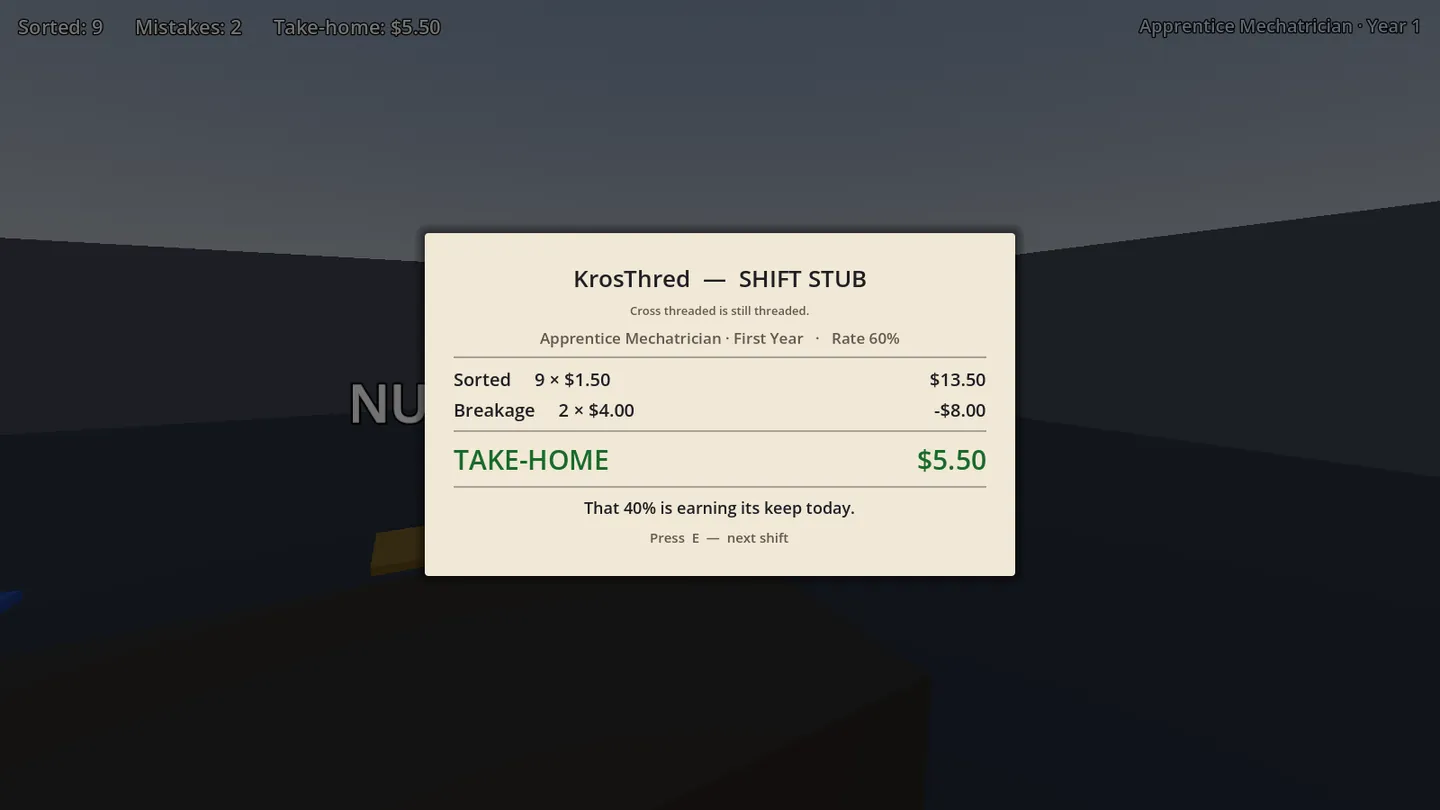
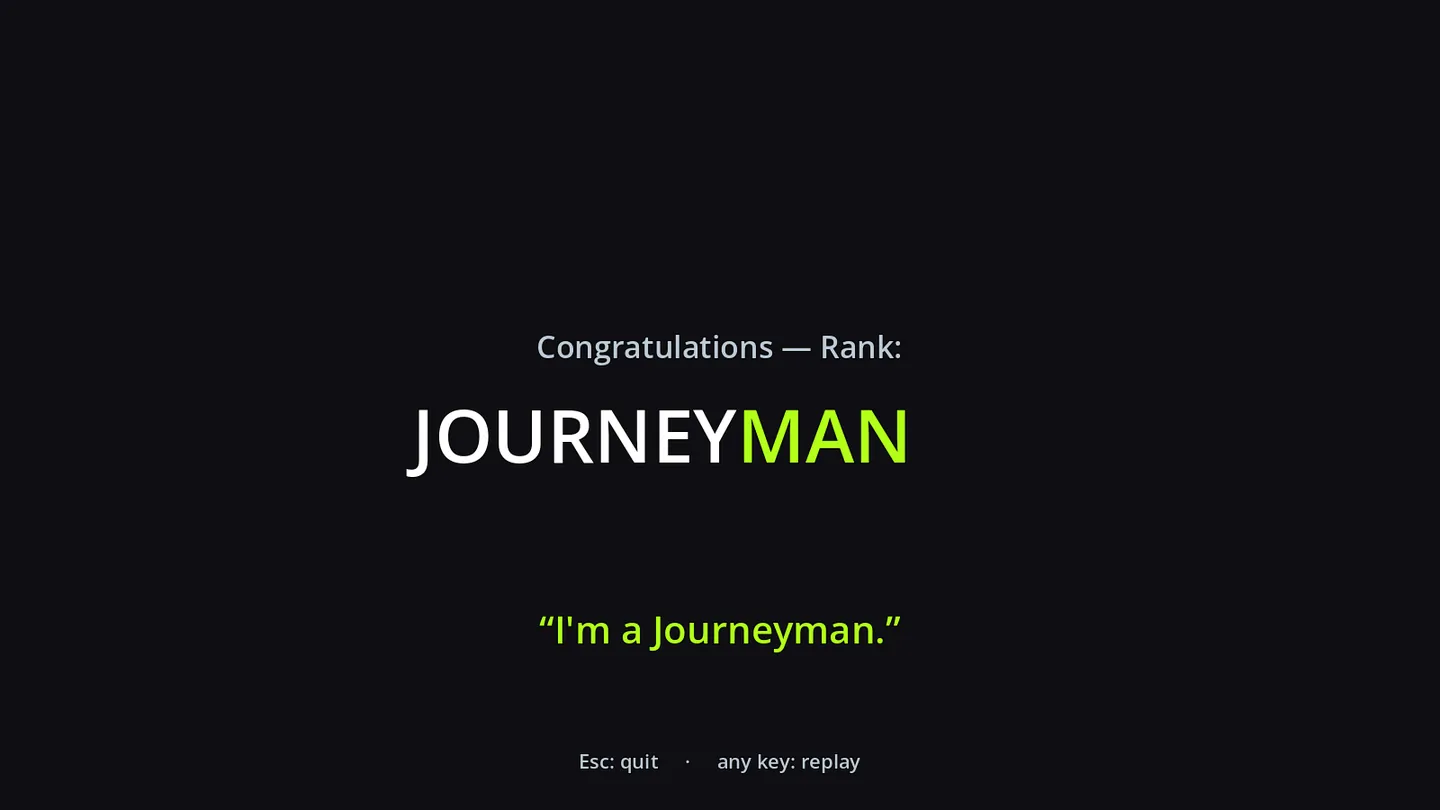
Pay is how the game keeps score. A sort is worth $2.50 at journeyman scale, and a first-year apprentice gets 60% of that, so $1.50. Each mistake costs $4.00 in breakage. When the bench is clear you get a paystub from KrosThred, the fictional shop, whose motto is "Cross threaded is still threaded." The ranks follow the real Alberta ladder: four apprentice years at 60, 70, 80 and 90 percent of scale, then Journeyman, Red Seal and Blue Seal. Jason confirmed those percentages.
Built with
- Engine: Godot 4 on Linux, using the Forward+ renderer, with Windows planned as the first export target and Linux and Steam Deck to follow.
- Language: GDScript, chosen for fast iteration and tight integration with the engine. C# or native extensions are reserved for any proven performance hotspot.
- Interaction: a first-person controller, a crosshair that turns green over anything you can grab, and look-to-place sorting. A fastener's collision is switched off while it's carried, and a dedicated aim ray picks the target bin.
- Humour as a system: a supervisor bark bank fires on wrong drops, and a shop radio plays 36 lines of ribbing aimed at about 20 trades. Both are data, so new lines are cheap to add.
- Economy: a live take-home figure on the HUD, and an end-of-shift paystub from KrosThred, the fictional shop.
- Art pipeline: the plan is licensed 3D models re-textured with the game's own parody brands, plus a unifying wear-and-grime pass so the shop looks used rather than assembled from a store. The concept art already gives every tool a parody brand.
- Authenticity: Jason, a working millwright, is the source of truth on fasteners, tools, ranks and shop culture. The rank ladder follows the real Alberta apprenticeship.
Where it stands
Build steps 1 and 2 of 7 are done: the first-person controller and the sorting loop, with the barks, the radio and the paystub. Jason playtested the sorting loop and said it was "much easier to sort," so the game's first question, whether this is fun, has a yes for sorting. Installing and torque come next, then progression that unlocks tools and rooms together. The roadmap's next milestone is a short demo, recorded footage, and putting it in front of tradespeople Jason knows.
Pictures